


A study landed on my desk this week that I can’t stop thinking about. It confirms something I’ve believed for 15 years but never had this clean a data set to back it up.
Self-Regulation Makes You a Better Shooter
Researchers at the University of Queensland published a study in Scientific Reports earlier this year. They took 66 elite special forces soldiers and randomly split them into two groups.
One group got 15 hours of emotional intelligence training. Not a weekend retreat. Not a meditation app. Structured training in recognizing, understanding, and regulating emotions in real time. This is the core of what I’ve written about extensively in self-regulated learning.
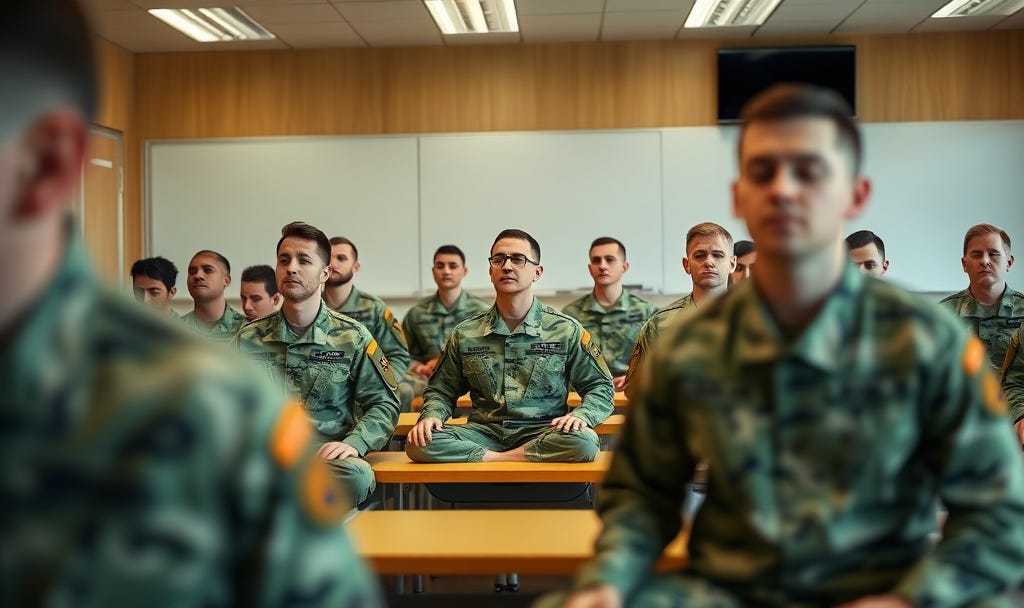
The other group got 15 hours of standard control training.
Then they dropped both groups into a high-stress simulated combat scenario, and they measured everything.
Cortisol levels. Shooting accuracy. Memory recall. Cognitive speed.
The EI-trained soldiers hit their targets 94.1% of the time.
The control group hit 51.6%.
Same soldiers. Same selection pipeline. Same physical conditioning. Same weapons.
Nearly double the accuracy.
But here’s the part that really got me.
The EI group recalled 66% more mission-critical details during the scenario. They solved complex problems faster under pressure. And their cortisol levels were measurably lower throughout.
They weren’t calmer because the situation was easier. They were calmer because they had learned to regulate their internal state while the chaos was happening around them.
This is the thing I’ve been trying to explain to every athlete, executive, and operator I’ve worked with. Stress isn’t the enemy. Your relationship with stress is.
I had an NBA player a few years back. Incredible talent. But in the fourth quarter of close games, he disappeared. Not because he lacked skill. Because his nervous system hijacked him. His heart would beat out of control and he’d basically hide in a corner. His decision-making collapsed. He looked like a completely different player.
We didn’t work on his jump shot. We worked on his breathing. We worked on him noticing when his chest tightened and naming it before it took over. We worked on the two-second gap between stimulus and response.
Within a season, his fourth-quarter numbers were unrecognizable. Same player. Same skill set. Different relationship with pressure.
That’s what this study quantified. 15 hours of training. Not years. Not a personality overhaul. 15 hours of learning to notice what’s happening inside you and choosing a response instead of reacting on autopilot.
Simone Biles is the highest-profile example of this. After Tokyo, everyone focused on the withdrawal. What they missed was the rebuild. She didn’t just get back in the gym. She got into therapy. Before her two biggest competitions in Paris, the team final and the all-around final, she had sessions with her U.S.-based therapist who was up in the middle of the night to work with her.
Then she won three golds and a silver.
She didn’t become a better gymnast between Tokyo and Paris. She became a better regulator. And that made her gymnastics better.
We have this cultural obsession with “mental toughness” that usually means “ignore your body and push through.” That’s not toughness. That’s dissociation. And it works right up until it doesn’t, which is usually the moment that matters most.
Real toughness is the opposite. It’s paying such close attention to your internal state that you can steer it in real time. That’s what those soldiers learned. That’s what Biles rebuilt.
Performance isn’t a trait you either have or you don’t. It’s a skill. And the foundation of that skill is self-regulation.
If 15 hours of training can nearly double accuracy in some of the most elite operators on the planet, what could it do for your team?
What I’m Reading
Emotional intelligence training improves stress regulation and performance in high-stress occupations (Scientific Reports, 2026). The full paper. Read the methodology section. They used objective physiological measures, not questionnaires. That’s what makes this study different from most EI research. If you need ammunition for why your organization should invest in emotional regulation training, this is it.
Born at the Wrong Time: Selection Bias in the NHL Draft (PLOS ONE). Completely different topic, but I’ve been obsessed with it this week. 40% of NHL players are born January through March because of age cutoffs. The kids born late in the year who survive the system become better players and earn 51% more. We’re filtering out talent everywhere and don’t even realize it.
Carol Dweck Revisits the Growth Mindset (Education Week). Worth re-reading. Dweck herself addresses how “growth mindset” has been distorted into “just try harder” when the real insight is about how you respond to failure. Connects directly to the self-regulation conversation.
One Thing to Try This Week
Next time you feel stress rising before a big moment, try this: name the physical sensation out loud to yourself.
“My chest is tight.”
“My hands are cold.”
“My breathing is shallow.”
That’s it. Don’t try to fix it. Just name it.
Neuroscientists call this “affect labeling.” Research consistently shows that naming an emotion or sensation reduces its intensity. It moves activity from the amygdala (your threat center) to the prefrontal cortex (your thinking center). It’s the same foundational skill those soldiers learned in their 15 hours of training.
Try it once this week. Before a presentation. A hard conversation. A moment where the stakes feel high. Name what’s happening in your body before you react.
It sounds too simple to work. That’s how you know it’s foundational.
See you next week!